TL;DR
Abstract
We present STARFlow, a scalable generative model based on normalizing flows that achieves strong performance in high-resolution image synthesis. The core of STARFlow is Transformer Autoregressive Flow (TARFlow), which combines the expressive power of normalizing flows with the structured modeling capabilities of Autoregressive Transformers. We first establish the theoretical universality of TARFlow for modeling continuous distributions. Building on this foundation, we introduce several key architectural and algorithmic innovations to significantly enhance scalability: (1) a deep-shallow design, wherein a deep Transformer block captures most of the model representational capacity, complemented by a few shallow Transformer blocks that are computationally efficient yet substantially beneficial; (2) modeling in the latent space of pretrained autoencoders, which proves more effective than direct pixel-level modeling; and (3) a novel guidance algorithm that significantly boosts sample quality. Crucially, our model remains an end-to-end normalizing flow, enabling exact maximum likelihood training in continuous spaces without discretization. STARFlow achieves competitive performance in both class-conditional and text-conditional image generation tasks, approaching state-of-the-art diffusion models in sample quality. To our knowledge, this work is the first successful demonstration of normalizing flows operating effectively at this scale and resolution.
Method
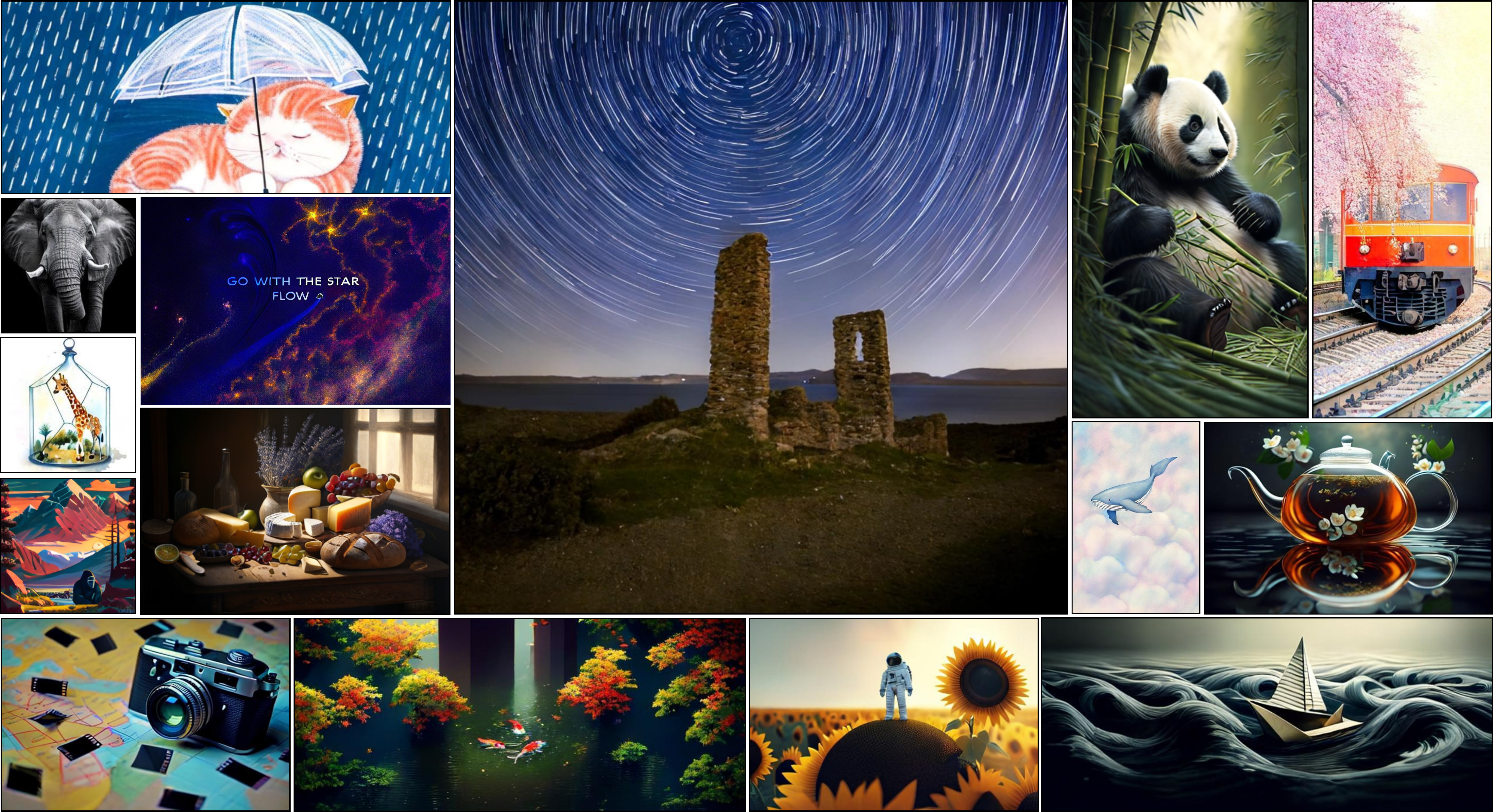
Overview figure from the paper — see the linked paper for full details.
Key Contributions
A deep–shallow design: a deep Transformer block carries most of the model's capacity, complemented by a few computationally efficient shallow blocks.
Modeling in the latent space of pretrained autoencoders rather than directly in pixels, which proves far more effective at high resolution.
A novel guidance algorithm that substantially boosts sample quality, with the model remaining an end-to-end maximum-likelihood normalizing flow.
BibTeX
@inproceedings{gu2025starflow,
  title     = {STARFlow: Scaling Latent Normalizing Flows for High-resolution Image Synthesis},
  author    = {Gu, Jiatao and Chen, Tianrong and Berthelot, David and Zheng, Huangjie and Wang, Yuyang and Zhang, Ruixiang and Dinh, Laurent and Bautista, Miguel Angel and Susskind, Joshua and Zhai, Shuangfei},
  booktitle = {Advances in Neural Information Processing Systems (NeurIPS)},
  year      = {2025}
}