TL;DR
Abstract
Autoregressive models have driven remarkable progress in language modeling. Their foundational reliance on discrete tokens, unidirectional context, and single-pass decoding, while central to their success, also inspires the exploration of a design space that could offer new axes of modeling flexibility. In this work, we explore an alternative paradigm, shifting language modeling from a discrete token space to a continuous latent space. We propose a novel framework TarFlowLM, that employs transformer-based autoregressive normalizing flows to model these continuous representations. This approach unlocks substantial flexibility, enabling the construction of models that can capture global bi-directional context through stacked, alternating-direction autoregressive transformations, support block-wise generation with flexible token patch sizes, and facilitate a hierarchical multi-pass generation process. We further propose new mixture-based coupling transformations designed to capture complex dependencies within the latent space shaped by discrete data, and demonstrate theoretical connections to conventional discrete autoregressive models. Extensive experiments on language modeling benchmarks demonstrate strong likelihood performance and highlight the flexible modeling capabilities inherent in our framework.
Method
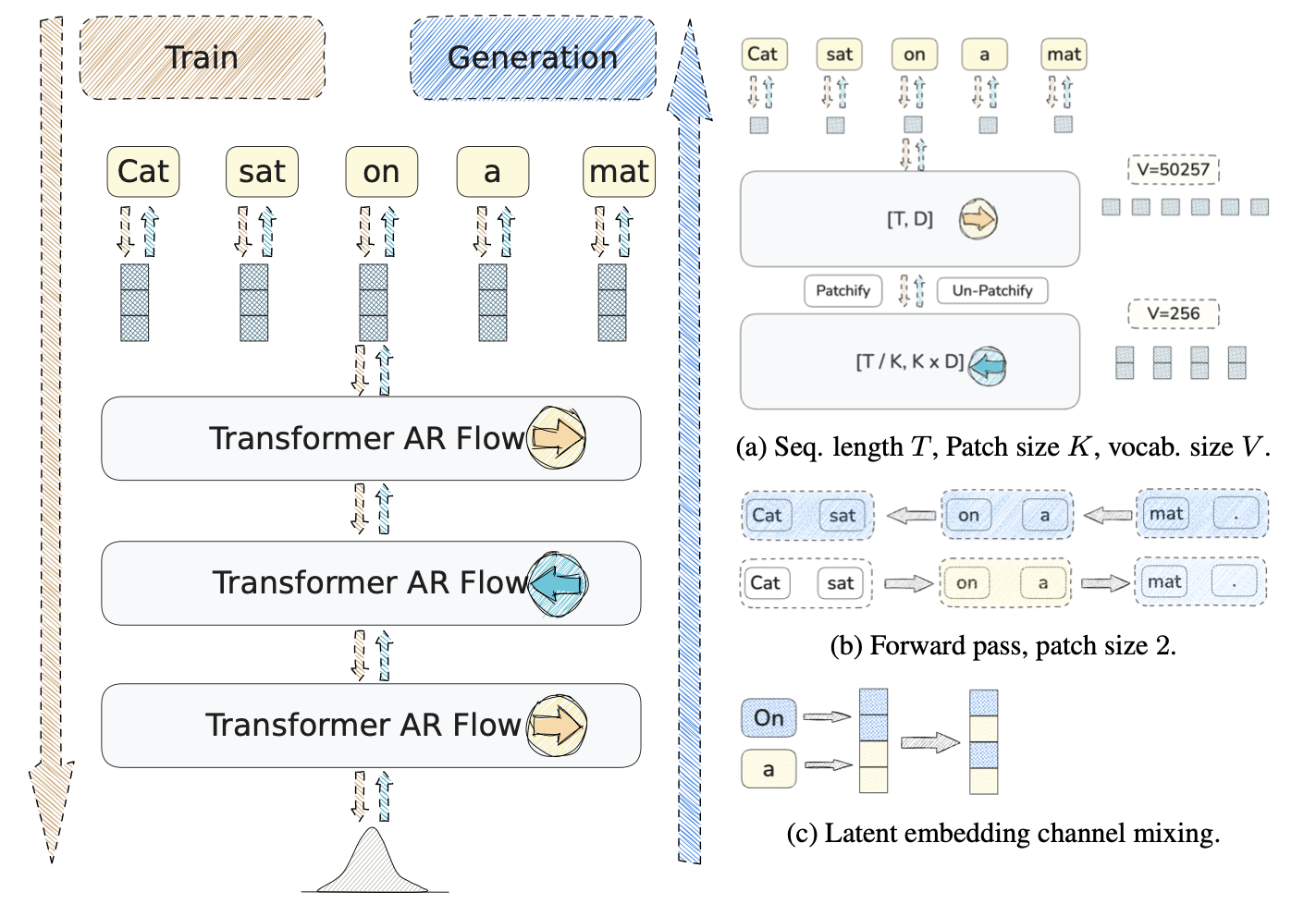
Overview figure from the paper — see the linked paper for full details.
Key Contributions
A continuous-latent-space language model built on Transformer-based autoregressive normalizing flows.
Flexible generation: global bidirectional context via alternating-direction transforms, block-wise generation with flexible patch sizes, and hierarchical multi-pass decoding.
New mixture-based coupling transformations for discrete-data latents, with theoretical connections to conventional discrete autoregressive models.
BibTeX
@inproceedings{zhang2025flexible,
  title     = {Flexible Language Modeling in Continuous Space with Transformer-based Autoregressive Flows},
  author    = {Zhang, Ruixiang and Zhai, Shuangfei and Gu, Jiatao and Zhang, Yizhe and Zheng, Huangjie and Chen, Tianrong and Bautista, Miguel Angel and Susskind, Joshua and Jaitly, Navdeep},
  booktitle = {Advances in Neural Information Processing Systems (NeurIPS)},
  year      = {2025}
}